club
The club is a short, heavy implement carried in Santiago's skiff for the specific purpose of subduing large fish once they are brought alongside. In the opening description of the old man's gear, the club is stored under the stern of the skiff along with the bait box, ready for use when a big fish is hauled in. It is a tool of the fisherman's trade, as ordinary and necessary as the gaff and the harpoon, and its presence signals the practical, violent work that follows a successful catch.
Role in the Marlin Fight
During the three-day struggle with the great marlin, the club remains stowed and unused. Santiago never reaches for it while the fish is still alive and fighting; his focus is on the line, the harpoon, and his own endurance. The club is reserved for the moment after the harpoon has been driven home, when the fish, though dying, must be dispatched or controlled. In the event, Santiago does not use the club on the marlin—he kills it with the harpoon alone—but the club's presence in the boat is a reminder of the standard procedure he has followed countless times before.
Weapon Against the Sharks
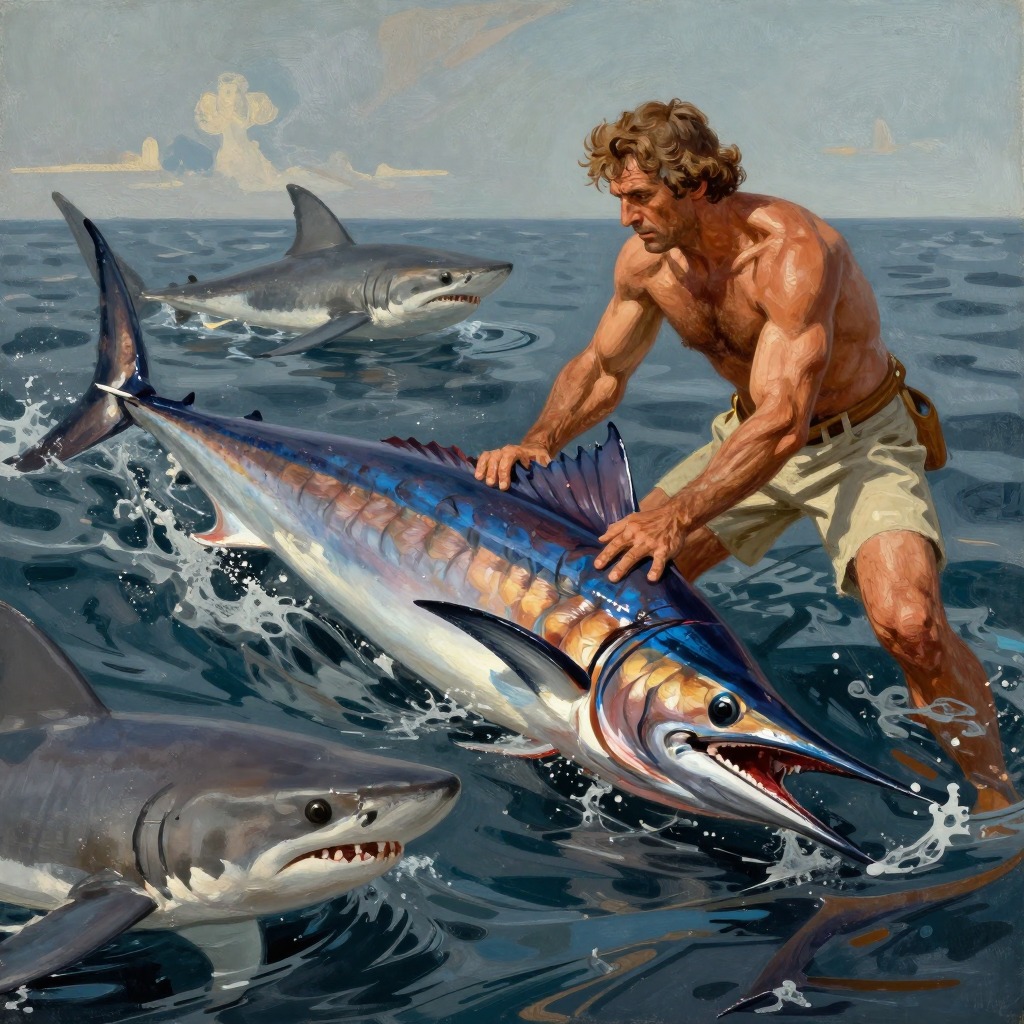
After the marlin is lashed to the skiff and the first shark—a Mako—has been killed with the harpoon, Santiago prepares for the next attacks by lashing his knife to the butt of an oar. When the shovel-nosed sharks (galanos) arrive, he uses the knife-oar combination, but the knife blade snaps during the third shark attack. With the knife gone, Santiago turns to the club as his primary weapon. He retrieves it from under the stern—a sawed-off oar handle about two and a half feet long—and waits for the next pair of galanos. He strikes the first shark on the top of its broad head, feeling the rubbery solidity and the rigidity of bone, then hits it again across the point of the nose. The second shark he strikes on the head as it closes its jaws, and he hits it again in the same place, feeling the bone at the base of the brain. Though he hurts both sharks badly, he cannot kill them with the club alone, and they retreat temporarily.
Loss and Final Failure
The club's inadequacy becomes clear during the midnight attack by a pack of sharks. Santiago clubs desperately at heads he can only feel and hear in the darkness, but the sharks tear at the marlin's carcass from all sides. In the chaos, something seizes the club and it is gone, wrenched from his hands. He then jerks the tiller free from the rudder and uses that as his final weapon, beating and chopping with it until it breaks. The loss of the club marks the moment when Santiago's ability to defend his prize is effectively ended; he is left with only the splintered butt of the tiller and his own resolve. The club, a simple tool of the fisherman's trade, proves insufficient against the relentless, organized predation of the shark pack, and its disappearance signals the old man's final, unremedied defeat.
Significance
The club is a symbol of the practical, limited means by which Santiago confronts the sea's violence. It is not a heroic weapon but a workman's tool, and its failure against the sharks underscores the disparity between the old man's skill and the overwhelming forces of nature. The club's loss, along with the broken knife and the lost harpoon, strips Santiago of his defenses and forces him to rely on his bare hands and whatever else remains in the boat. In the end, the club's absence is part of the larger pattern of depletion that leaves the marlin a skeleton and Santiago exhausted, yet undefeated in spirit.